

Dear Scientists, Mathematicians, Engineers and Researchers from Around the World.
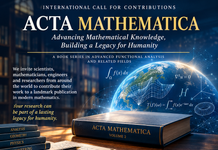
ACTA MATHEMATICA — Advancing Mathematical Knowledge, Building a Legacy for Humanity
What if the ideas we develop today could become part of the scientific heritage of future generations?
What if a mathematical discovery made in one country could inspire a breakthrough on another continent?
And what if the collective efforts of researchers from different disciplines could help shape the future of scientific knowledge?
With this vision in mind, we warmly invite scientists, mathematicians, engineers, university academics and researchers from all corners of the world to contribute their work to ACTA MATHEMATICA, an international academic initiative dedicated to the advancement, preservation and dissemination of mathematical knowledge.
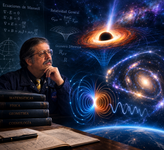
Under the academic direction of Dr Francisco Bulnes, this initiative seeks to bring together original research, innovative ideas, theoretical developments and scientific applications in a work that aspires to become a lasting intellectual legacy for humanity.
We invite interested researchers to take the first step by submitting an abstract outlining their proposed contribution.
Your idea could become part of something greater: a collective record of the mathematical thinking, scientific discoveries and intellectual challenges that define our time.
1. ACTA MATHEMATICA: A Meeting Place for Scientific Minds
Mathematics is far more than a collection of equations, theorems and formal demonstrations.
It is a universal language through which humanity explores the structures underlying nature, technology, physical reality and abstract thought.
Throughout history, mathematical progress has emerged from the exchange of ideas between individuals, institutions and nations.
Each generation inherits the achievements of its predecessors and adds new questions, methods and discoveries to the body of human knowledge.
ACTA MATHEMATICA seeks to contribute to this enduring tradition.
The initiative provides an academic framework for presenting and sharing research in advanced mathematics and related scientific disciplines.
Its purpose extends beyond the publication of individual contributions: it seeks to encourage intellectual dialogue, promote interdisciplinary collaboration and preserve research that may inspire further discoveries.
Every rigorous demonstration, original method, promising conjecture and meaningful application can contribute to the continuing development of science.
By bringing these contributions together, ACTA MATHEMATICA aspires to help build a scientific record that future researchers can consult, examine and extend.
2. A Broad and Challenging Field of Mathematical Research
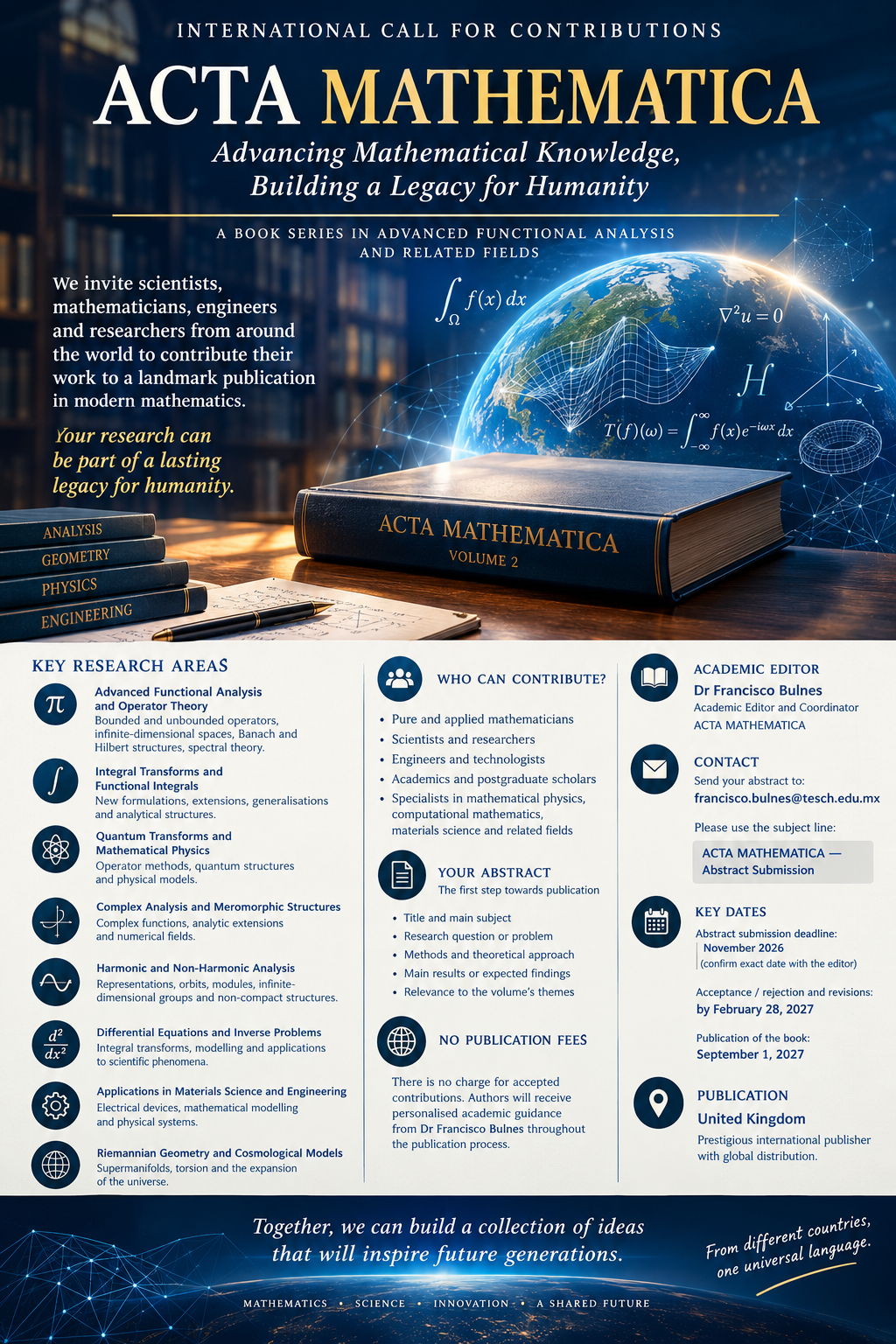
The forthcoming volume, entitled Advanced Functional Analysis and Integral Transforms: Functional Integrals and Quantum Transforms, focuses on advanced mathematical subjects with important connections to contemporary scientific research.
Researchers are particularly encouraged to consider contributions in the following areas:
Advanced Functional Analysis and Operator Theory
Research into bounded and unbounded operators, infinite-dimensional spaces, spectral theory and the mathematical structures of Banach and Hilbert spaces.
Contributions may explore new theoretical developments, operator properties and applications to problems arising in mathematical physics and other disciplines.
Integral Transforms and Functional Integrals
Studies of integral transforms, their extensions and generalisations, functional integration and related analytical structures.
Research may investigate new formulations, mathematical properties and applications to complex scientific problems.
Quantum Transforms and Mathematical Physics
Contributions examining the mathematical foundations of quantum transformations, operator-based formulations and connections between functional analysis, quantum structures and physical models.
Complex Analysis and Meromorphic Structures
Research involving meromorphic domains, complex functions, analytical extensions and the relationships between complex analysis and functional spaces.
Harmonic and Non-Harmonic Analysis
Studies of harmonic analysis, non-harmonic structures, representations, group actions, orbits and generalised modules, including questions concerning infinite-dimensional representations and non-compact groups.
Differential Equations and Inverse Problems
New analytical methods, integral-transform techniques and mathematical approaches to differential equations, inverse problems, modelling and the interpretation of scientific phenomena.
Mathematics, Materials Science and Engineering
Research exploring mathematical methods arising from materials science, engineering applications, electrical devices, mathematical modelling and the analysis of physical systems.
Geometry, Riemannian Structures and Cosmological Models
Investigations into Riemannian geometry, supermanifolds, geometric structures involving torsion and mathematical approaches to models of the expanding universe.
These subjects provide a framework for prospective contributions rather than an exhaustive list.
Researchers whose work connects with the volume’s central themes are encouraged to enquire about the suitability of their proposed chapters.
3. An Invitation Across Disciplines and Borders
ACTA MATHEMATICA welcomes the participation of established academics, early-career researchers, postgraduate scholars and independent researchers with relevant scientific contributions.
We particularly encourage collaboration among:
- Pure and applied mathematicians.
- Scientists working in theoretical and experimental research.
- Engineers developing mathematical models and analytical methods.
- Researchers in mathematical physics and quantum theory.
- Specialists in computational mathematics and scientific computing.
- Academics investigating connections between mathematics, materials science and engineering.
- Researchers exploring new relationships between established mathematical disciplines and emerging scientific fields.
Scientific progress frequently occurs at the boundaries between disciplines.
A problem originating in engineering may require a new mathematical formulation; an abstract theorem may reveal an unexpected physical application; and a technique developed in one branch of mathematics may open new possibilities in another.
ACTA MATHEMATICA seeks to encourage these intellectual connections and to provide a setting in which diverse perspectives can contribute to the advancement of knowledge.
4. Your Abstract: The First Step Towards a Lasting Contribution
Researchers interested in participating are invited to submit an abstract describing their proposed chapter.
The abstract should clearly communicate:
- The title and principal subject of the proposed contribution.
- The research problem or question being addressed.
- The mathematical methods, theoretical framework or scientific approach employed.
- The principal results, expected findings or original contribution.
- The relevance of the work to the themes of ACTA MATHEMATICA.
Authors are encouraged to present their ideas clearly, precisely and concisely, highlighting what makes their research significant.
An abstract provides the editorial team with an initial overview of the proposed work.
Its submission should not be understood as a guarantee of acceptance or publication; prospective contributions remain subject to the applicable editorial requirements and evaluation process.
Researchers may also contact the academic editor to enquire about chapter requirements, submission guidelines and the next steps following the initial abstract.
5. No Publication Fees: An Opportunity to Contribute Without Financial Charges
One of the important conditions of this invitation is that there is no publication fee for participating authors, according to the announced call.
Researchers are invited to contribute their knowledge and scientific work without a publication charge being imposed for the inclusion of an accepted chapter under this arrangement.
Furthermore, participating authors are offered personalised academic guidance from Dr Francisco Bulnes during the chapter preparation and publication process.
The initiative is intended to encourage scientific participation and to make collaboration possible without publication fees becoming a financial barrier.
The planned publication in the United Kingdom and the intended international distribution offer a further opportunity for accepted contributions to reach academic readers beyond the authors’ immediate institutions and countries.
Specific publication, distribution and indexing arrangements should be confirmed with the editorial team.
6. Academic Direction and Contact Information
The initiative is coordinated academically by Dr Francisco Bulnes, whose work is associated with advanced mathematics, geometry, operator theory and mathematical physics.
Researchers interested in submitting an abstract, discussing a proposed chapter or obtaining further information about participation are invited to contact:
Dr Francisco Bulnes Academic Editor and Coordinator, ACTA MATHEMATICA
Email: francisco.bulnes@tesch.edu.mx
Please use the subject line: ACTA MATHEMATICA — Abstract Submission
In your message, include your proposed chapter title, abstract, principal research area and institutional affiliation, where applicable. You may also indicate whether you are seeking guidance on the suitability of your proposed contribution.
The editorial team can provide further information about the submission procedure, chapter specifications and relevant deadlines.
7. A Scientific Legacy for Future Generations
The significance of a scientific publication cannot be measured solely by the number of pages it contains or the number of contributions it brings together.
Its deeper value lies in the questions it inspires, the connections it establishes and the discoveries it may help make possible.
A mathematical result published today may become the foundation for tomorrow’s research. A theoretical insight may inspire a new engineering application.
A carefully formulated question may guide an entire generation of investigators.
This is why the preservation and dissemination of scientific knowledge matter.
ACTA MATHEMATICA aspires to be more than a collection of research chapters: it seeks to contribute to the intellectual memory of our age.
Its enduring ambition is to bring together the work of researchers from different countries, academic traditions and scientific disciplines, creating opportunities for dialogue and preserving contributions that may prove valuable to future generations.
The mathematical heritage of humanity has never been the achievement of a single nation or generation.
It has been built through the accumulated efforts of countless minds, each adding a new piece to a much larger intellectual structure.
Every generation has the opportunity — and the responsibility — to contribute to that structure.
This is your invitation to take part.
Join ACTA MATHEMATICA
If you are a scientist, mathematician, engineer or researcher with an original idea, a theoretical development, a mathematical method or a significant scientific application, we encourage you to submit your abstract for consideration.
Bring your questions.
Share your discoveries.
Present your methods.
Explore new connections.
Contribute to a scientific endeavour that seeks to preserve the knowledge of today and inspire the discoveries of tomorrow.
The next meaningful contribution to mathematics may emerge from an unexpected question, a new perspective or a collaboration between researchers who have never met.
Perhaps your work will provide that missing connection.
Perhaps your idea will inspire another researcher to pursue a question that has yet to be answered.
And perhaps, years from now, your contribution will help a future generation see a mathematical problem in an entirely new light.
The future of mathematics is not written by one mind alone. It is built through the ideas we develop, the knowledge we share and the discoveries we make possible together.
We look forward to welcoming your contribution to ACTA MATHEMATICA.
From different countries, one universal language. From different disciplines, one shared pursuit of knowledge. From today’s research, a legacy for humanity.